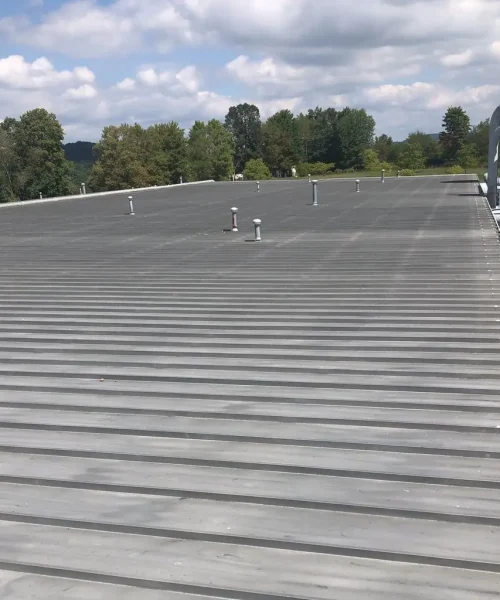
Wood Education and Resource Center Metal Roof Repairs
Client
Wood Education and Resource Center (WERC)
Federal Government Facility
Project Type(s)
Commercial Roof Repair
Metal Roof Leak Repair,
Pipe Penetration Repair
Government Project
Location
Princeton, West Virginia
Project Overview
Our crew at RTG Solutions handled targeted leak repairs across the facility roof, concentrating on panel seams, fastener lines, and the penetrations that interrupt the roof plane. The goal was straightforward: get the roof back to “quiet,” meaning no mystery leaks, no spreading water stains, no constant reaction mode after every hard rain.
Because this is a government-operated facility, the approach also had to be clean and controlled. No sloppy sealant work, no half-prepped surfaces, no “we’ll see if it holds.” The repair points needed to be prepped properly, sealed properly, and left holding strong.
This federally funded project in West Virginia required prevailing wage compliance and exacting standards. RTG Solutions was trusted to perform critical maintenance on a massive 40,000-square-foot commercial metal roof and a 23,500-square-foot PVC roof. Our scope of work included resealing thousands of fasteners, addressing every pipe penetration, and filling pitch pockets to restore watertight performance. The success of this job led to repeat contracts with the USDA in Pennsylvania, where our team completed three additional shingle re-roofs. Projects like these highlight our ability to work within government requirements while delivering cost-effective, high-quality repairs at scale.
Location
Princeton sits in the southern part of West Virginia, where roofs get hit with soaking rains, humid summers, and the kind of freeze-thaw cycling that loves to work fasteners loose over time. On a large roof, that wear does not show up as one obvious failure. It shows up as little pathways opening at overlaps and penetrations, and water does what it always does, it finds the path of least resistance.
Since this is a government facility, we understood the urgency of the repairs to make sure they could continue their invaluable work. When water starts showing up inside, it affects operations, equipment, and the basic ability to use the space the way it was intended.
Roof System and Materials
The roof conditions pointed to the kind of leakage you see on metal systems when details start aging: exposed fastener lines, panel laps, and penetrations that have lost their tight seal. So the work focused on stabilizing those areas with metal-roof-appropriate prep and sealing, not just smearing product and hoping for the best.
On the Special Use Building metal roof, the scope called for removing existing sealant at approximately 3,800 roof screws using mechanical abrasion (wire brush or similar), then resealing those screws with urethane sealant. Pipe penetrations were handled the same disciplined way: remove previously applied liquid sealant at approximately 29 pipe penetration boots, then reapply urethane sealant so the boot-to-roof connection is restored and watertight.
On the Main/Office Building, the scope centered around the details that typically start leaking first on a commercial roof: pitch pockets, drainage components, coping joints, and penetrations. That meant topping off pitch pockets with new pourable sealant, replacing broken downspout straps, and removing and replacing deteriorated sealant at scuppers, coping joints, and pipe penetration collars.
About the Client
The Wood Education and Resource Center is a federal facility operated by the USDA Forest Service and built around wood products education, training, and applied research. It is a specialized site with labs, training areas, and equipment that simply should not be dealing with routine water intrusion.
Our team’s work ensured the facility was secure and dry, so the work inside the building can keep moving, week after week, without worrying about the wild West Virginia weather.
Project Scope
- Performed leak-focused assessment of the metal roof field, seams, fastener lines, and penetrations
- Special Use Building (approximately 40,000 sq ft metal roof): remove existing sealants at approximately 3,800 screws using mechanical abrasion and reseal screws with urethane sealant
- Prepped repair areas with cleaning and surface preparation suitable for metal roof sealing
- Main/Office Building: top off pitch pockets with new pourable sealant
- Main/Office Building: replace broken downspout straps
- Main/Office Building: remove and replace deteriorated sealant at scuppers, coping joints, and pipe penetration collars
- Seal exposed fasteners and fastener rows where leakage risk was present
- Seal panel laps and seam conditions to reduce water travel beneath overlapping metal.
- Addressed localized detail areas where water was collecting or tracking, as conditions required
- Complete closeout walk-through to confirm repair points were clean, sealed, and stable
Related Searches:
Schedule a Commercial Roof Assessment
Need an estimate, scope validation, or documentation for budgeting and planning? Tell us what you are seeing and we will be in touch!
Quality Highlights
A project like this lives or dies in the small stuff. You can have a metal roof that looks fine from the parking lot and still have water sneaking in through tired sealant at fasteners and penetrations. This scope took the unglamorous parts seriously, across a large roof footprint, and brought those details back into a stable, watertight condition.
Fastener sealing performed at scale, without getting sloppy
Thousands of screws means thousands of chances to miss one. The scope required methodical sealant removal and surface prep, then urethane reseal application that stays consistent across the roof instead of looking good for twenty feet and falling apart after the first rain.
Penetrations and drainage details cleaned out and resealed the right way
Penetration boots, pitch pockets, scuppers, coping joints, collars. These are the spots that quietly turn into callbacks when they are rushed. This scope targeted them directly, with clean-out and reseal work designed for continuity and water control, not cosmetic coverage.
Government facility expectations met with a controlled approach
On a federal-linked site, the work has to be repeatable and defensible. The scope leaned into that: defined quantities, defined methods, and repair details that can be inspected, maintained, and trusted.