IHOP Roof Repairs and Preventative Maintenance
Client
IHOP
Commercial Property
Project Type(s)
Commercial Roof Repair,
Single-Ply Roof Repair
Roof Penetration Repair
Preventative Roof Maintenance
Location
State College, Pennsylvania
Project Overview
A restaurant are brutal on a roof. Constant HVAC use, grease exhaust equipment, foot traffic from service techs, and the fact that a leak can shut down dining and hurt the business. This IHOP in State College had an aging single-ply flat roof that needed repairs in more than one spot, because older membrane systems often fail in clusters.
We handled this as two coordinated repair visits on the same building. The first addressed active leak areas and obvious weak points around equipment and transitions. The second followed up with additional repairs where the roof was still vulnerable, including more patching and sealing work tied to preventative maintenance, penetrations, seams, and perimeter conditions. The goal was to stop the water that’s getting in, and tighten up the details that usually become the next leak after the first one is handled. We also sealed and reinforced adjacent details that tend to open up next, buying the owner time and reducing the odds of another callout a month later.
Location
State College in Pennsylvania is not gentle on commercial roofs. You get freeze-thaw cycles that work fasteners and terminations loose, snow and ice that sit on low-slope sections, wind-driven rain that finds weak flashing, and those temperature swings that make an older membrane move more than people expect.
A restaurant roof in this area also has a predictable set of stress points: rooftop units sitting on curbs, pipe penetrations and terminations that have been patched more than once, and perimeter transitions where the membrane meets vertical walls or equipment bases. If the roof is already in the later stage of its life, those details frequently lead to leaks and other issues with the roof.
Repairs and Materials
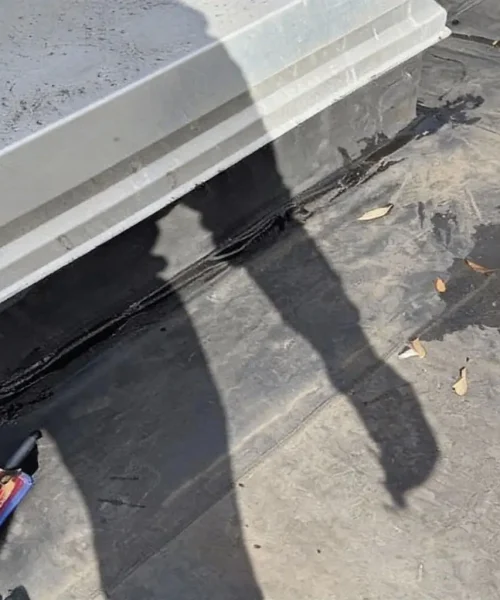
Both repair visits focused on getting back to watertight continuity on a single-ply membrane roof. That means surface prep, clean tie-ins, and patches that actually marry into the existing system instead of floating on top of dust, moisture, or old residue. Our team at RTG outlined repair areas, localized patches, did sealant work at transitions, and detailed repairs around equipment and penetrations where water was getting in.
Work areas included rooftop unit curbs and the membrane transitions around mechanical equipment, seam and field repairs where the membrane showed wear and prior patch history, and penetration-related details where sealant and flashing conditions tend to break down over time. We also addressed perimeter and wall transition areas with targeted sealing, because that joint is one of the most common “slow leak” sources on commercial flat roofs. One day it looks fine. Then a hard rain and a wind shift happens and suddenly you’re drenched.
Material-wise, we used compatible repair components for a single-ply system: membrane patches sized to cover suspect areas with room to tie in properly, and commercial-grade sealant where sealant is actually the right tool (termination and detail work), not a substitute for a real flashing condition. In other words, patches where patches belong, sealing where sealing belongs, and attention to the transitions that decide whether the repair holds.
About the Client
The IHOP in State College is a popular spot in the community. Our team knew we needed to do the work well and ensure that we did not disrupt day to day operations. We worked around rooftop units that kept the building running, kept the site safe, and solved the problem quickly enough that it didn’t turn into interior damage, customer complaints, or a recurring maintenance headache for the GM.
Project Scope
- Evaluate reported leak areas and inspect common failure points on the existing single-ply flat roof
- Complete a first round of targeted roof leak repairs, focusing on seams, penetrations, and rooftop unit curb transitions
- Return for a second repair visit to address additional vulnerable areas on the same roof, including more patching and detail sealing
- Install localized membrane patches at defined repair areas to restore continuity in the field of the roof and around equipment
- Perform sealing and detail work at wall transitions and perimeter conditions where water intrusion risk was elevated
- Maintain controlled, safe work practices around rooftop equipment and active building use
Explore More About:
Schedule a Commercial Roof Assessment
Need an estimate, scope validation, or documentation for budgeting and planning? Tell us what you are seeing and we will be in touch!
Quality Highlights
A commercial roof repair either reduces the building’s leak risk for the next season, or it just moves the leak to the next weak link. On this IHOP in State College, the two-visit approach was about doing the first part right, then coming back to finish tightening the roof where it still needed attention, with repairs that double as practical preventative maintenance until a longer-term plan makes sense.
Focused leak stopping at the usual suspects
Rooftop units, penetrations, and wall transitions are where commercial flat roofs quietly fail. The repairs targeted those points directly, with patching and sealing work designed to hold through weather and movement, not just look “covered” on day one.
Repairs focused on roof life extension
When a single-ply roof reaches the stage where multiple areas need attention, the smartest repair approach is the one that reduces future leak probability while you’re already up there. That’s what we did across both visits by tightening adjacent details instead of treating each repair as an isolated island.
Clean execution on an operating commercial building
Roof repairs on a restaurant can’t create new problems: debris, loose materials, unsafe access, sloppy terminations. The work stayed controlled, with repairs that were clearly laid out, prepped, and finished with attention to tie-ins.